


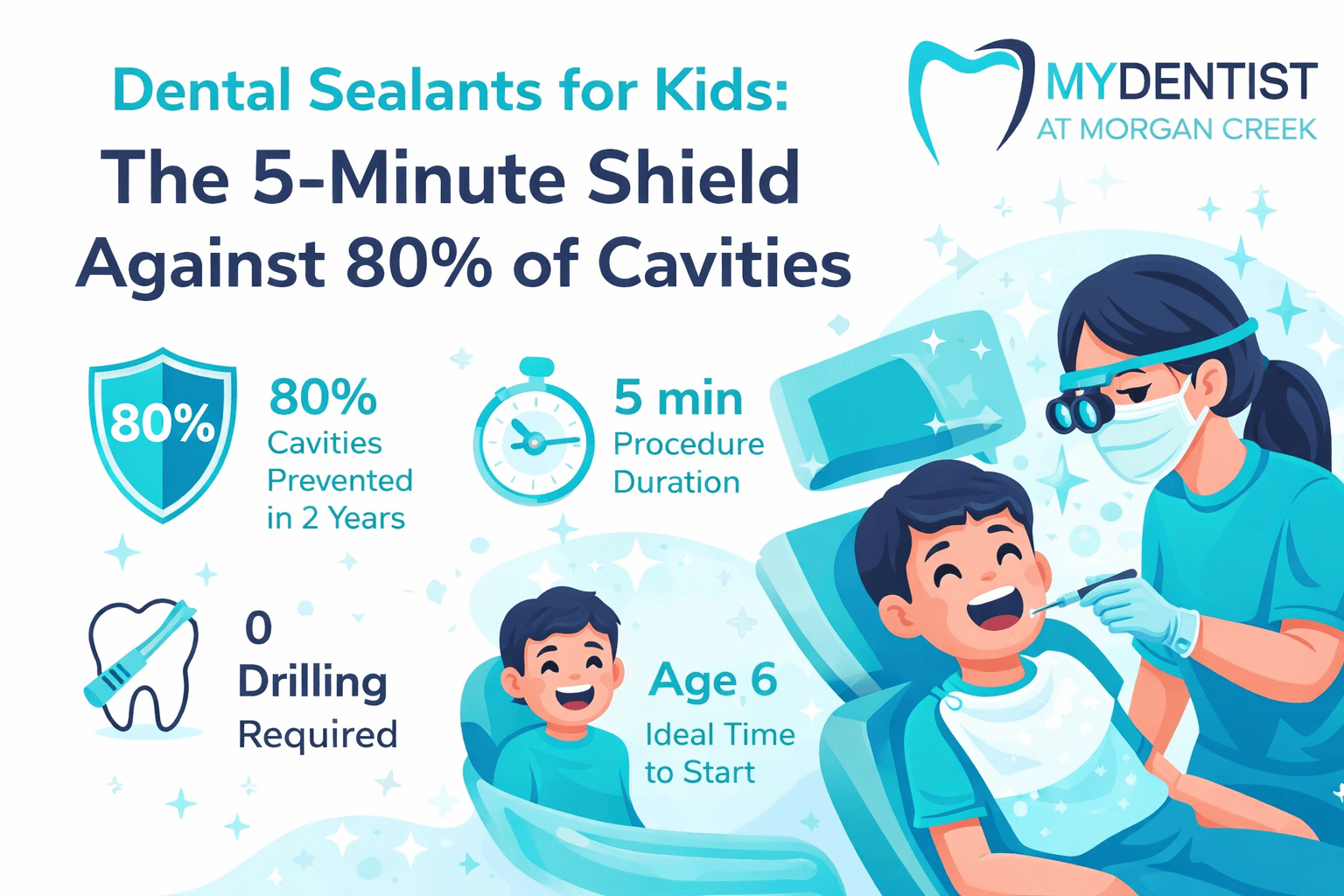
Dental Sealants for Kids:
The 5-Minute Shield
Against 80% of Cavities
One quick, painless visit. Years of protection. Here’s everything South Surrey parents need to know.
in 2 Years
Duration
Required
to Start
Picture a Tuesday evening in Morgan Creek. Dinner’s cleared, the bath is running, and now comes the nightly negotiation: “Open wider, please. No, the back teeth.” If you’ve ever tried to scrub a seven-year-old’s molars with a toothbrush, you already understand the challenge. Those back teeth are critical, they’re hard to reach, and they’re the teeth most likely to develop cavities. The good news? There’s a simple, drill-free solution that can dramatically change the trajectory of your child’s dental health in roughly the same time it takes to brew a cup of coffee.
Dental sealants are one of the most thoroughly researched preventive tools in modern dentistry, and yet many families across South Surrey and White Rock have either never heard of them or aren’t quite sure what they involve. At My Dentist at Morgan Creek, we believe that an informed parent is a confident parent. So let’s break it all down: the science behind sealants, how the procedure actually works, what the research says about safety, and why the timing of treatment matters more than most people realize.
The Number That Changes Everything: Why 80% Matters
According to data from the U.S. Centers for Disease Control and Prevention (CDC) and endorsed by the American Dental Association (ADA), dental sealants reduce the risk of decay in back molars by approximately 80% within the first two years of application — and continue to offer protection against around 50% of cavities for up to four years after that. A systematic review published by the Cochrane Library on resin-based sealants supports these findings, ranking sealants among the most effective preventive dental interventions currently available for children.
To understand why those numbers matter so much, consider this: the back molars account for the vast majority of cavities that develop in school-age children. They are the teeth your child uses most heavily for chewing every single day, and they’re also the most structurally difficult teeth to clean properly, even when a child brushes consistently and well.
A single sealant application at the right time can significantly reduce the odds that those teeth will ever need a filling. For Morgan Creek families who value quality care and practical efficiency, that’s a compelling equation: one short, comfortable appointment today could mean no drills, no local anaesthetic, and no dental anxiety for years to come.
Why Even Excellent Brushers Can’t Win Without Sealants
Here’s something that genuinely surprises many parents: most cavities in the back molars don’t form because a child brushes badly. They develop because of where bacteria hide. The chewing surfaces of permanent molars are covered in a network of deep grooves and microscopic valleys, structures dentists call pits and fissures. Under a dental microscope, these grooves can resemble the walls of a narrow canyon.
Imagine trying to clean the floor of a deep, narrow ravine using a brush that’s wider than the opening. That’s the challenge toothbrush bristles face every time they meet the chewing surface of a back molar. Food particles and bacteria slip into those fissures and stay there, quietly producing the acid that breaks down enamel over time.
A dental sealant addresses this problem at its source. Rather than attempting to clean a groove that’s simply too narrow to access, the sealant fills and seals it, as a result, eliminating the hiding spot entirely. The tooth’s chewing surface becomes smooth, easy to clean, and resistant to the bacterial colonies that trigger decay. Think of it as closing a door that was always slightly ajar.
Unsealed Molar
- Deep pits trap food and bacteria
- Bristles can’t reach groove floors
- Acid accumulates unnoticed
- Enamel slowly erodes
- Filling becomes necessary, often within a few years
Sealed Molar
- Grooves filled and sealed with resin
- Smooth surface brushes clean easily
- Bacteria have no place to shelter
- Enamel stays intact and strong
- Cavity risk dramatically reduced for years
Step-by-Step: What Actually Happens in Those 5 Minutes
One of the most effective ways to reduce dental anxiety, for both children and their parents, is transparency. When everyone in the chair knows exactly what’s coming next, the entire experience is calmer. Here’s an honest, step-by-step look at how dental sealants are applied at My Dentist at Morgan Creek. There are no drills, no needles, and no discomfort involved at any stage.
Polish & Clean
The dentist gently polishes the tooth’s chewing surface to clear away any plaque or debris. It feels no different from the cleaning portion of a routine check-up appointment.
Rinse & Dry
The tooth is rinsed clean and thoroughly dried. Keeping the surface dry is important for a strong bond, so a small absorbent pad or gentle air stream will be used throughout.
Etching Gel Applied
A very mild acidic gel, far gentler than the natural acids in fruit juice, is applied to the tooth surface for a few seconds. This creates a microscopically textured surface that allows the sealant resin to grip the enamel firmly.
Sealant Painted On
The liquid dental resin is carefully painted onto the chewing surface, flowing into the grooves and fissures. The material is thin, clear or slightly tinted, and completely painless to apply.
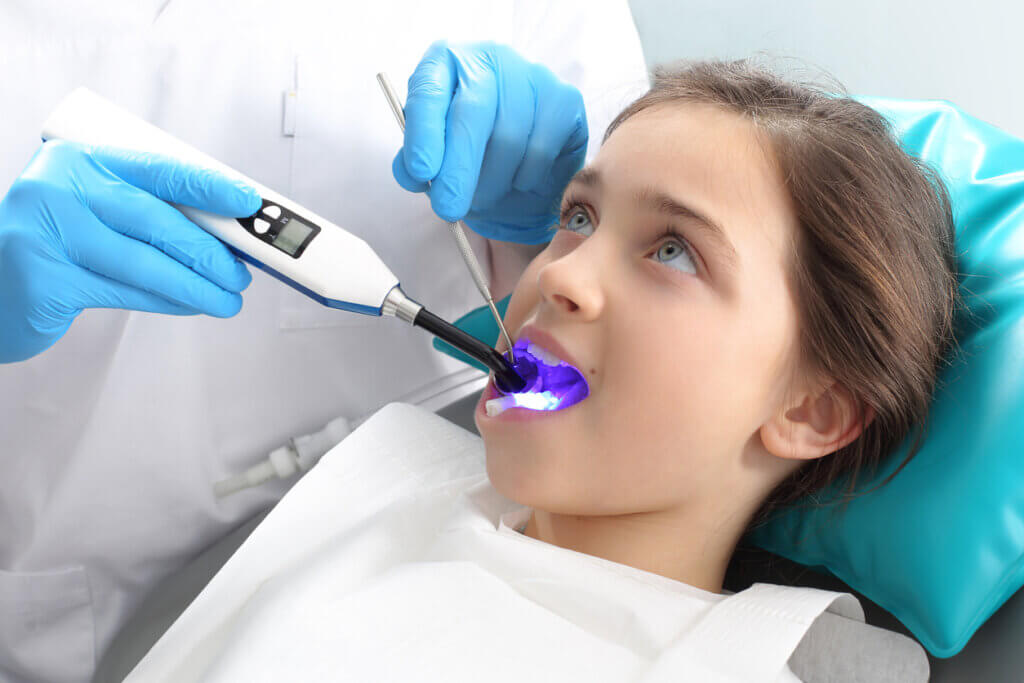
Cured With Blue LED Light
A special curing light, a cool blue LED, hardens the sealant in a matter of seconds. The result is a durable, protective coating that bonds firmly to the enamel and is ready for use immediately.
That’s the entire process. Your child can eat and drink normally right after the appointment. There’s no recovery time, no lingering soreness, and no special aftercare instructions to follow. Most children are genuinely surprised by how easy it is — and parents often walk out wondering why they hadn’t asked about sealants at an earlier visit.
Addressing the BPA Question: Safety First
Health-conscious families in South Surrey ask smart, thoughtful questions and one we hear regularly is: “Are dental sealants safe? I’ve heard something about BPA.” It’s a completely fair concern, and the research offers a reassuring answer.
Some dental resin materials contain trace amounts of BPA precursor compounds. However, peer-reviewed research and regulatory reviews consistently demonstrate that the actual BPA exposure from a dental sealant is negligible, measuring well below the levels encountered through everyday environmental exposure, such as breathing air near common plastics or handling a thermal paper receipt. The ADA affirms that the measurable benefits of sealants in preventing childhood tooth decay substantially outweigh any theoretical concern from trace BPA exposure.
If you have specific questions about the materials used at our practice, our team is always happy to walk you through the details before any procedure begins. Transparent, unhurried conversations about your child’s care are something we consider a core part of what we do – not an optional extra.
The Golden Window: When to Book That Appointment
Timing is one of the most important and most frequently overlooked factors in getting the most out of dental sealants. They work best when applied to a freshly erupted tooth that shows no signs of decay. There are two key windows in your child’s dental development to watch for.
First Window
The first permanent molars typically arrive around age six. Sealing these teeth promptly protects them through the most cavity-prone years of childhood, which is roughly ages six through twelve.
Second Window
The second set of permanent molars generally emerges around age twelve. Applying sealants as these teeth come in provides the same protective layer heading into the teenage years.
Missing these windows doesn’t necessarily mean sealants are no longer an option, but the ideal scenario is application on a clean, freshly erupted tooth with no existing decay. If you’re unsure whether your child’s molars have fully come in yet, that’s a great question to raise at their next routine check-up. Our team will assess eruption progress and advise you on exactly the right timing for your individual child.
How Long Do Sealants Last?
With normal wear, dental sealants can remain intact and effective for several years. Studies have documented measurable protection extending well beyond the initial two-to-four-year window highlighted in the CDC and Cochrane data. The key to maximizing longevity is having sealants reviewed at every routine dental visit. Our dentists check the integrity of existing sealants as part of every examination, and a worn or chipped sealant can be refreshed quickly and painlessly without any additional preparation, ensuring your child’s protection remains continuous. For most families, this means the investment of one short appointment delivers years of ongoing coverage with only minor maintenance along the way.
Sealants vs. Fillings: The Preventive Advantage
Consider the alternative for a moment. A cavity in a child’s molar typically requires, at minimum, a tooth-coloured composite filling. That means numbing the area, removing the decayed tissue with a drill, and placing a restoration. Even in the most gentle and experienced hands, that process involves a needle, a drill, and a fair amount of time; none of which is easy to explain to a seven-year-old beforehand, or to soothe them through on the day.
Then factor in the longer view: fillings require maintenance, replacement over time, and potential further treatment if decay advances before it’s detected. Each restorative visit carries the risk of reinforcing dental anxiety, which can compound into a lifelong pattern of avoidance for some children.
Sealants offer a fundamentally different path: prevent the cavity before it ever starts. No drill. No needle. No anxiety. At My Dentist at Morgan Creek, we’ve seen firsthand how a child’s early dental experiences shape their attitude toward oral health for decades to come and we consider preventive procedures like sealants one of the most meaningful gifts we can offer the families we serve.
Do Sealants Replace Brushing and Flossing?
This is an important point worth stating clearly: dental sealants are one layer of a complete oral health strategy, not a substitute for good daily habits. Sealants protect the deep grooved chewing surfaces of back molars, but they do not cover the sides of teeth, the spaces between teeth, or the gum line. Brushing twice daily with fluoride toothpaste and flossing remain essential for your child’s overall dental health.

What sealants do is remove one of the most persistent points of failure in children’s dental hygiene, those inaccessible grooves in the back molars where most childhood cavities actually begin. With those grooves sealed, brushing can focus on the surfaces it can actually reach and clean effectively. Think of sealants not as a replacement for your child’s routine, but as the piece that makes the routine work the way it was always intended to.
Coverage in BC: A Preventive Investment Most Plans Support
Here’s more good news for Morgan Creek families: because dental sealants are classified as a preventive treatment, the majority of BC dental benefit plans, including group plans offered through many employers across the Lower Mainland, cover sealants for children, often at 100% of the standard fee. Insurers recognize that covering a low-cost preventive procedure is far more economical than funding restorative treatment down the line, which is why sealants tend to be among the most consistently covered items in a child dental benefit schedule.
Coverage terms vary by plan, so if you’re unsure what your benefits include, our front desk team is experienced at navigating BC dental plans and happy to help you review your coverage before your child’s appointment. No surprises, no confusion, just clear information so you can make the best decision for your family with full confidence.
Why South Surrey Families Choose My Dentist at Morgan Creek
Our practice was built on a straightforward philosophy: exceptional dental care shouldn’t feel intimidating, and prevention is always the most powerful form of treatment. Families come to us from across South Surrey and White Rock because they want a team that listens carefully, explains things clearly, and genuinely invests in their children’s wellbeing, not just today, but across a lifetime of dental health.
Our approach to sealants reflects exactly that. We assess each child individually, explain every step in language that both kids and parents can actually follow, and create an environment where a visit to the dentist is something children feel at ease with from the very beginning. Our Morgan Creek team applies sealants with efficiency, accuracy, and a gentle touch. We also take the time to answer every question before we begin.
We’re proud to be woven into this community. Helping South Surrey kids grow up cavity-free, one molar at a time, is one of the most rewarding parts of what we do and we’d love to welcome your family to the practice.
Protect Your Child’s Smile
Book a check-up or routine visit at My Dentist at Morgan Creek. We’ll assess whether your child is ready for sealants and walk you through every step without any pressure or any surprises.
Frequently Asked Questions
Everything South Surrey parents ask us about dental sealants.
Do dental sealants hurt?
No, dental sealants are one of the most comfortable preventive procedures in dentistry. There is no drilling, no injections, and no discomfort at any stage. Most children find the process completely painless and are genuinely surprised by how quick and easy it is. The etching gel used to prepare the tooth surface may have a slightly sour taste, but it is applied briefly and is entirely harmless.
At what age should my child get dental sealants?
The ideal timing is as soon as the permanent molars fully erupt, which is typically around age six for the first molars and around age twelve for the second molars. The goal is to seal these teeth before any decay has a chance to develop. Your dentist will assess eruption progress during routine visits and advise the right timing for your specific child.How long do dental sealants last?
With normal wear, dental sealants can last several years, with research showing measurable protection extending well beyond four years in many cases. Sealants are routinely checked at every dental visit. If any have worn down or chipped, they can be reapplied quickly and painlessly without additional preparation. Regular check-ups are the key to maintaining continuous protection.
Are dental sealants safe? What about BPA?
Yes, dental sealants are considered safe by the ADA and major dental health authorities. While some sealant materials contain trace BPA precursors, the actual BPA exposure from a dental sealant is measurably lower than what a person encounters through everyday environmental contact, such as breathing near common plastics or handling a thermal receipt. The ADA affirms that the protective benefit of sealants substantially outweighs any theoretical concern about trace exposure. If you’d like to discuss the specific materials used at our practice, we’re always happy to walk you through them.
Does my BC dental plan cover sealants?
In most cases, yes. Because dental sealants are a preventive treatment, the majority of BC dental benefit plans cover them for children, often at 100% of the standard fee. Coverage terms vary by plan, so we recommend checking with your provider or asking our front desk team, who can help you review your specific benefits clearly before the appointment.
Can adults get dental sealants, too?
While sealants are most commonly applied to children’s newly erupted permanent molars, adults with deep grooves on teeth that show no existing decay or fillings can also benefit. Ask your dentist during your next routine visit to assess your individual teeth and let you know whether sealants are appropriate for you.
Do sealants mean my child doesn’t need to brush and floss?
No, sealants are one protective layer within a complete oral health routine, not a replacement for brushing and flossing. They seal the deep grooves on the chewing surfaces of back molars but do not protect the sides of teeth, spaces between teeth, or the gum line. Brushing twice daily with fluoride toothpaste and flossing regularly remain essential. Sealants simply close off the hardest-to-clean areas so that brushing can work effectively on the surfaces it can reach.