


Why Infant Dental Care Starts Before the First Tooth
It is 2 a.m., your baby is drooling through the third bib of the night, and you are searching “dentist near me” with one thumb while you rock with the other arm. Is this teething? Should you be cleaning anything yet? Does a baby really need a dentist?
Those are the questions we hear most from new parents, and the honest answers are simpler than the internet makes them sound. Infant dental care starts before the first tooth appears, because the gums, the bacteria in your baby’s mouth, and the feeding habits you set in the first months all shape how the teeth will fare later.
At My Dentist at Morgan Creek, we are a family dental clinic in South Surrey that serves families from South Surrey and White Rock. Our general dentists work with children and parents to give practical advice and encouragement about oral hygiene. We aim to help every child feel safe and comfortable in the dental chair, and we know parents often need reassurance too.

In this guide, we cover when teeth usually arrive, why baby teeth matter, what helps teething, how to clean your baby’s mouth, how to prevent early cavities, and what happens at a first dental visit. Call us whenever something in your baby’s mouth worries you.
When Do Babies Get Their First Tooth?
Most babies cut their first tooth at about 6 months, but the range is wide. The Canadian Paediatric Society (CPS) says a first tooth can appear as early as 3 months or as late as 12 months, and that most children have all 20 baby teeth by age 3 (CPS, Caring for Kids). According to HealthLink BC, the two bottom front teeth usually come first, then the upper front teeth, followed by the first molars, the canines, and the remaining molars.
Baby Tooth Eruption Overview (Approximate)
| Teeth | Usual Order | Approximate Timing |
| Central front teeth | First | 6 to 12 months |
| Lateral front teeth | Second | 9 to 13 months |
| First molars | Third | About 1 to 2 years |
| Canines | Fourth | 16 months to 2 years |
| Second molars | Last | About 2 to 3 years |
Good to know: Every baby develops differently. If you are unsure whether your child’s tooth development is normal, ask a dentist.
Why would a dentist see a baby with one tooth, or none? The Canadian Dental Association (CDA) recommends an assessment within 6 months of the first tooth or by the first birthday, so a dentist can spot risks before problems begin. At that age we check gums and bite, talk through feeding habits, and show you how to clean. A full set of teeth is not required.
Why Baby Teeth Matter
Baby teeth do far more than fill a smile. They help your child chew and eat well, support clear speech, hold space for permanent teeth, and guide those teeth into position as the jaws grow. Healthy teeth also help a child feel confident smiling and talking with others.
“They fall out anyway” is the objection we hear most. Some baby teeth stay in the mouth until about age 12, according to the CDA, so a back molar may need to last a decade. Decay in a baby tooth can also hurt, and the CPS notes that this pain can make it hard for a child to sleep, eat, or speak, and may affect concentration. Children who get decay early are also more likely to keep getting it. Our post on why baby teeth matter and what early tooth loss can cause goes deeper.
Picture a two-year-old who has started refusing crunchy foods and waking at night, while her parents assume it is a phase. A dentist finds a small cavity on a back tooth. Caught early, a filling can stop decay from spreading, as the CDA points out. Left alone, the tooth may become painful, and losing it too early can let neighbouring teeth drift into its space.
Key takeaway for parents: Baby teeth are small but do big jobs. Caring for them now can mean simpler care later.
Teething: What Is Normal and What Helps
Quick answer: What helps teething pain safely?
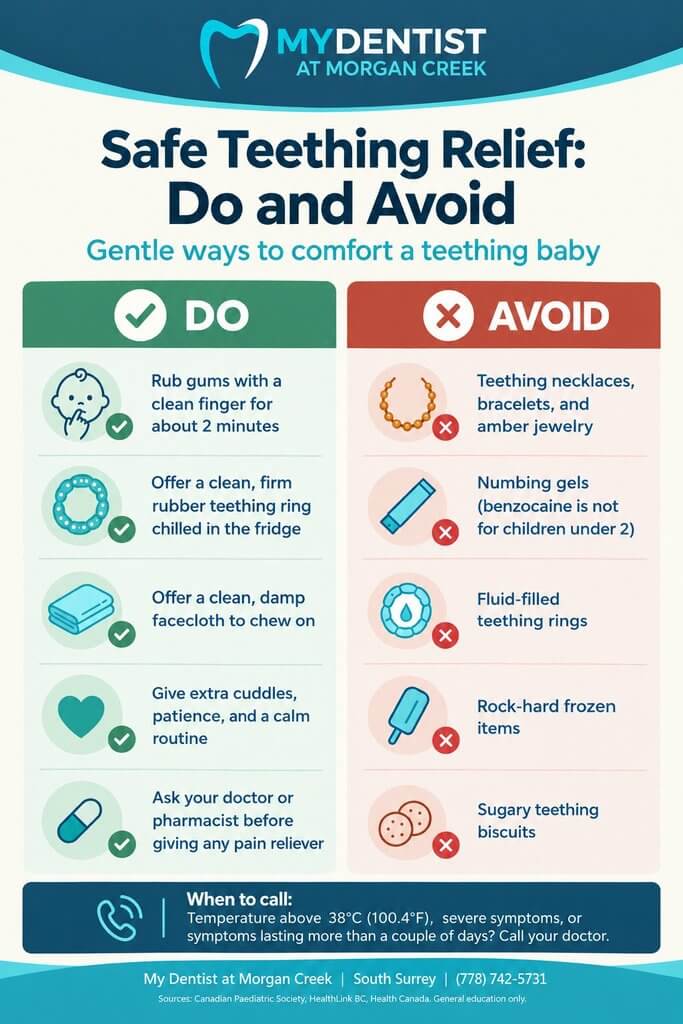
- Rub your baby’s gums with a clean finger for about two minutes at a time.
- Offer a clean, firm, solid teething ring that you have chilled in the fridge.
- Offer a clean, damp facecloth to chew on.
- If your baby seems truly uncomfortable, ask your doctor or pharmacist about a pain reliever labelled for your baby’s age.
HealthLink BC describes teething as the normal process of baby teeth breaking through the gums. Symptoms tend to start three to five days before a tooth appears and fade once it breaks through. Common signs include extra drooling, chewing on fingers and toys, tender gums, fussiness, and sometimes a drool rash on the chin or chest. Teething may cause a mild rise in temperature, but HealthLink BC advises looking for another cause if it climbs above 38°C (100.4°F).
Normal Teething Signs vs. Signs That Need Attention
| Usually Normal | Contact Your Doctor or Dentist |
| More drooling than usual | Temperature above 38°C (100.4°F), or any fever in a baby under 6 months |
| Chewing on fingers, toys, or a teething ring | Symptoms that become severe or last longer than a couple of days |
| Tender, slightly swollen gums | Refusing feeds or fluids |
| Fussiness for a few days before a tooth appears | White or brown spots on a tooth, or visible decay |
| Drool rash on the chin, face, or chest | Facial swelling, or an injury to the mouth or teeth |
What to skip matters just as much. Health Canada advises parents not to use benzocaine products, the numbing ingredient in many gels, for children under 2 because of a serious blood condition called methemoglobinemia (Health Canada). The CPS also warns that babies may swallow gels and that teething biscuits may contain sugar. Teething necklaces and bracelets, including amber ones, have been linked to strangulation and choking, and Canadian paediatricians discourage them (Paediatrics & Child Health). HealthLink BC also advises against fluid-filled rings, and rock-hard frozen items can feel harsh on tender gums. Extra cuddles and patience count as comfort measures too, for you as well as your baby.
Infant Dental Care Before Teeth Appear: Cleaning Your Baby’s Gums
Quick answer: how should parents clean a baby’s gums and first teeth? Wipe the gums with a clean, damp cloth or a soft infant brush once or twice a day. When the first tooth appears, brush it with a soft infant toothbrush, especially at bedtime.
The CDA suggests cleaning your baby’s gums once a day before teeth arrive, and the CPS suggests twice a day from birth. Either way, you remove milk residue and teach your baby that having a clean mouth is routine, which makes brushing easier once teeth come in.
Here is a bedtime routine that works for many families:
- Finish the last feed, then take the bottle away so baby does not fall asleep with it.
- Wash your hands and wrap a clean, damp cloth around your finger.
- Lay your baby on your lap or a flat surface, and wipe the gums gently, top and bottom.
- Follow with a book or a song, then bed.
If you breastfeed close to sleep, clean the gums or teeth afterward, as the CPS recommends. Breast milk is the healthiest choice, but it contains natural sugars, and mouths make less saliva overnight.
How to Care for the First Tooth
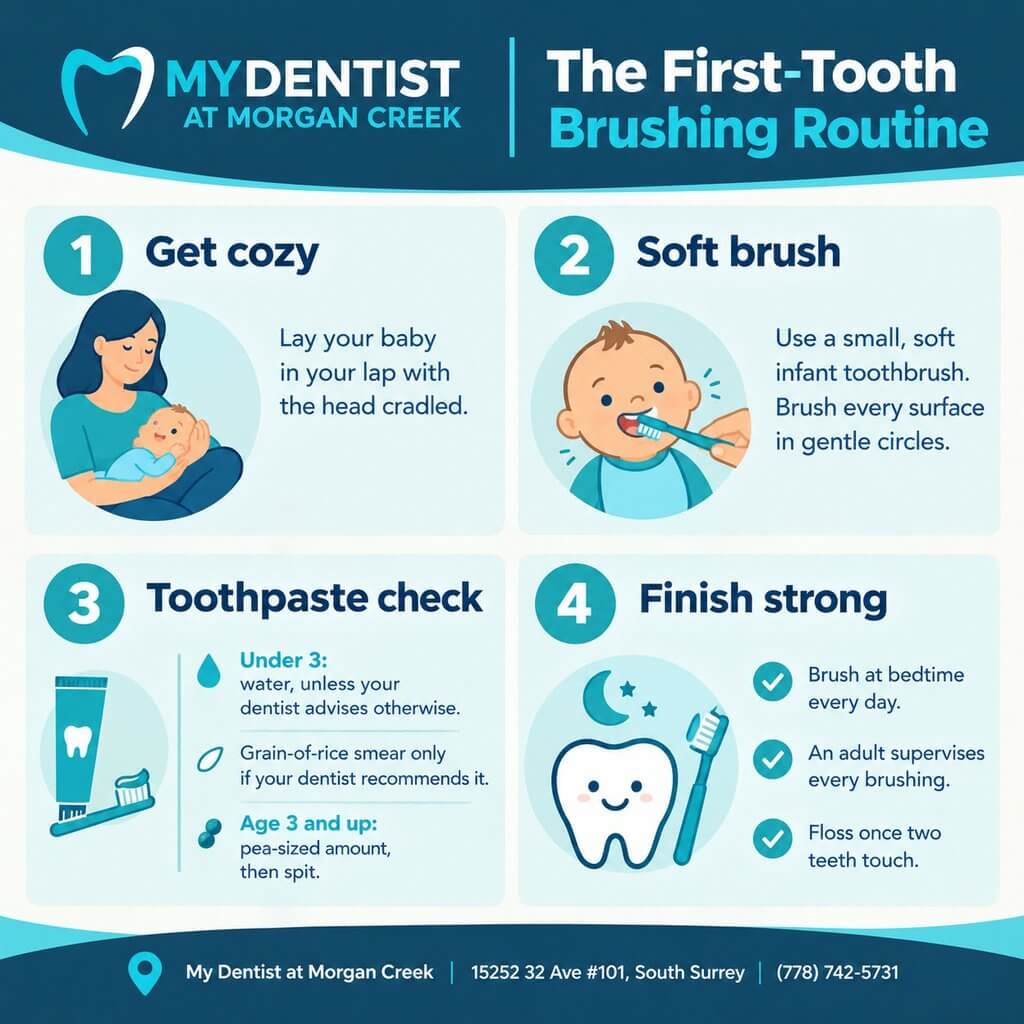
When that first tooth breaks through, switch from the cloth to a small, soft-bristled infant toothbrush. Lay your baby in your lap with the head cradled, and brush every surface with small, gentle circles. The CPS recommends brushing at least once a day, usually at bedtime, while the CDA recommends twice a day once teeth appear. Twice daily is a good target, and bedtime is the one you should protect.
Toothpaste confuses many parents, so here is the guidance in plain terms. The CDA says to brush with water alone for children under 3, unless your dentist or another health professional recommends fluoride toothpaste. If your child is at higher risk of decay, a smear about the size of a grain of rice may make sense (CDA, Infant & Toddler Oral Care). From age 3, use a pea-sized amount and teach your child to spit. Fluoride strengthens enamel, and swallowing too much while teeth form can cause white spots called fluorosis, which the CPS says are usually mild. An adult should supervise every brushing. Once two teeth touch, add gentle flossing between them.
Infant Oral Care by Age and Stage
| Age or Stage | Cleaning | Toothpaste | Also Do |
| Birth to first tooth | Wipe gums with a damp cloth once or twice daily | None | Keep bottles out of bed; plan the first visit |
| First tooth (often around 6 months) | Soft infant brush, at least at bedtime | Water, unless your dentist advises otherwise | Book a visit within 6 months, by age 1 |
| 1 to 2 years | Brush daily or twice daily; floss where teeth touch | Grain-of-rice smear only if your dentist advises | Switch to a regular cup at 12 to 15 months; check for spots monthly |
| 3 to 4 years | Brush twice daily for 2 minutes; adult finishes | Pea-sized fluoride toothpaste; spit, do not swallow | Keep regular dental visits |
Not sure which toothpaste approach fits your baby? Ask at the first dental visit. Our dentists can look at your baby’s teeth, talk through feeding and risk, and tell you whether a small smear of fluoride toothpaste makes sense. That personal guidance is the heart of good infant dental care.
Preventing Early Childhood Cavities
Quick answer: can babies get cavities? Yes. Baby teeth have thinner enamel than permanent teeth, according to the CPS, so decay can start soon after teeth appear.
Cavities follow a simple chain of events. Bacteria in the mouth feed on sugars and produce acid, and acid softens enamel. How often teeth meet sugar matters as much as how much. Sweet liquids, including formula, milk, juice, and breast milk, all contain sugar, so a baby who sips or nurses through the night gives bacteria a long, steady meal.
Realistic changes beat perfect ones. If a bottle is the only way your baby falls asleep, shift gradually to water in the bottle. After 6 months, the CPS suggests introducing a sippy cup, skipping juice (or keeping it under 125 mL a day, in a cup, with a meal), and moving to a regular cup between 12 and 15 months. Never sweeten a soother, and avoid putting a soother or bottle nipple in your own mouth, because bacteria can pass between you and your baby. Sharing spoons carries the same risk. For older toddlers, see our parents’ guide to sugar and children’s teeth.
Daily Cavity-Prevention Checklist for Babies and Toddlers
- Gums or teeth cleaned after the last feed and before bed
- Bottle out of bed, never propped, never carried around
- Water between meals instead of juice or sweet drinks
- Toothpaste used only in the amount your dentist advised
- No sharing spoons, and no cleaning a soother or nipple in your own mouth
- Once a month: lift the upper lip and look for chalky white or brown spots
- Next dental visit on the calendar
Common mistake to avoid: Letting a baby fall asleep with a bottle of milk, formula, or juice. Pooled liquid bathes the teeth for hours. If your baby needs the bottle to settle, use water, and make cleaning part of the bedtime routine.
If you ever see a white or brown spot, call My Dentist at Morgan Creek. A dentist can tell whether it is early decay and what to do about it.
Pacifiers, Thumb Sucking, and Oral Habits
Pacifiers and thumb sucking are normal in infancy. They soothe babies, and most children move past them without lasting effects. Trouble can start when a habit continues for years, because steady pressure can shift teeth and affect the bite. Our post on thumb sucking and pacifier habits notes that concerns often grow once a habit lasts past age 4 or 5.
The CPS suggests limiting soother use to naps and bedtime once your child is between 1 and 2, and talking with your doctor or dentist if thumb sucking continues as permanent teeth begin to arrive around age 5 or 6. Gentle reduction beats a sudden stop: narrow the habit to sleep times, offer a soft toy or blanket instead, praise the nights without it, and skip scolding. If a habit is hard to shift, ask us. We can check how the teeth are coming in and suggest a plan.
Your Baby’s First Dental Visit and Infant Dental Care in South Surrey
Quick answer: when should a baby first see a dentist? The CDA recommends a dentist assess your baby within 6 months of the first tooth appearing, or by the first birthday (CDA, Your Child’s First Visit).
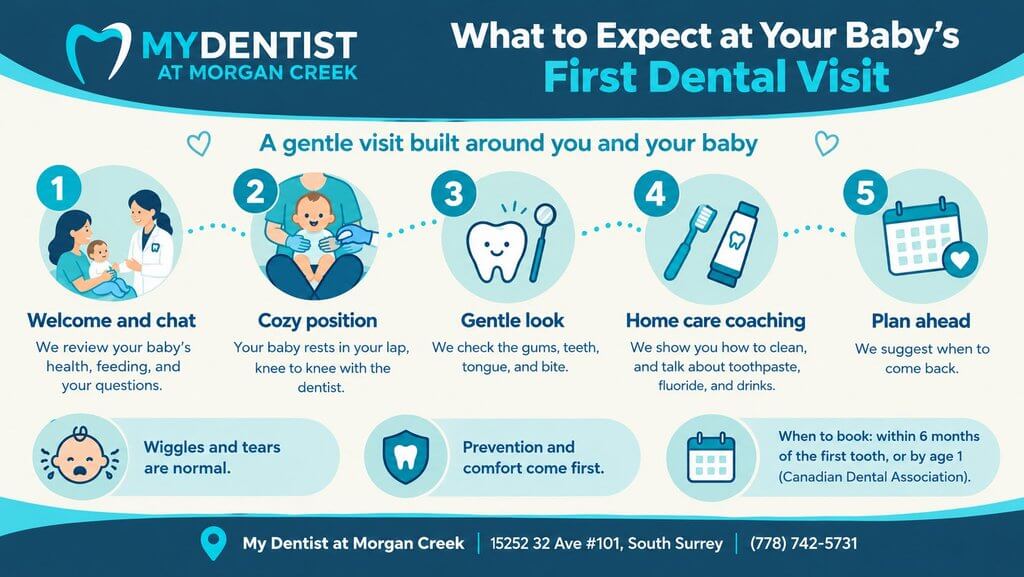
A first visit is short, gentle, and mostly conversation. The dentist may sit knee to knee with you while your baby rests in your lap. Some wiggling and crying is normal and does not mean the visit is going badly. Typically, we will:
- Review your baby’s health and feeding history, including breast, bottle, and solids.
- Look at the gums, teeth, tongue, and bite.
- Check that teeth are arriving as expected.
- Talk about cleaning, toothpaste and fluoride, and what your baby drinks.
- Answer every question you bring.
The goal is prevention and comfort, not complicated treatment. If your dentist has a concern, such as early decay, they will explain it plainly and discuss options. Fluoride varnish or X-rays come up only when the dentist judges they will help your child. Our guide on preparing your child for the first dental appointment has more ideas for making the day easy.

First-Dental-Visit Preparation Checklist
- Choose a time when your baby is usually fed and rested
- Write down your questions, including teething, pacifiers, and night feeds
- Note how your baby feeds and any health conditions or medications
- Bring a favourite comfort item and a pacifier if your baby uses one
- Complete the new patient form before you arrive, if you can
- Stay calm and positive, because babies pick up on nerves
Why choose us for your baby’s first visit? We are a family dental clinic, so parents and children can often book checkups on the same day at one South Surrey location. Our general dentists care for children regularly, and we keep visits friendly and gentle. To be clear, our dentists are general dentists, not pediatric specialists. If your child ever needs care beyond what a general dental office provides, we will tell you.
How My Dentist at Morgan Creek Supports Families
We see our role as helping parents do the daily work well. A visit with us can include a first checkup, preventive advice, oral hygiene instruction, a conversation about fluoride, and monitoring of your child’s tooth development. We also treat concerns such as cavities or early tooth loss, and as children grow we can talk about sealants for permanent molars and mouth guards for sports. You can read more on our kids’ dentistry page.
At-Home Infant Dental Care vs. Professional Dental Support
| Area | What You Do at Home | What Your Dentist Adds |
| Cleaning | Daily gum and tooth cleaning, especially at bedtime | Shows technique and checks for areas you may miss |
| Fluoride | Use toothpaste only as advised | Assesses risk and advises on toothpaste, varnish, or other options |
| Feeding and drinks | Water between meals, bottle out of bed | Reviews your baby’s feeding pattern without judgment |
| Spotting problems | Monthly lip-lift check for spots | Examines teeth, gums, and bite, and finds changes you cannot see |
| Habits | Limit pacifier and thumb sucking gradually | Watches how habits affect teeth and suggests next steps |
Frequently Asked Questions
When should my baby first see a dentist?
Within 6 months of the first tooth appearing, or by the first birthday, based on CDA guidance.
How often should children visit the dentist?
Many children do well with checkups about every six months. Your dentist may suggest a different schedule based on your child’s needs.
Can babies get cavities?
Yes. Baby teeth have thin enamel, and sugars in milk, formula, juice, and snacks can feed decay-causing bacteria. Cleaning teeth and limiting sipping can reduce the risk.
Is fluoride toothpaste safe for babies?
In small amounts, with supervision, it can be. The CDA says children under 3 should brush with water unless a dentist or health professional recommends fluoride, with a grain-of-rice smear for higher-risk children. Ask your dentist what suits your baby.
What should I do if my baby refuses brushing?
Keep it short, calm, and at the same time every day. Let your baby hold the brush, try a different position, sing, and praise. Do not force it. If brushing stays hard for weeks, we can help you troubleshoot.
Are teething gels safe?
Health Canada advises against benzocaine products for children under 2, and the CDA and CPS do not recommend gels. Use a clean finger or a chilled teething ring instead.
Can I use a pacifier?
Yes, in moderation. Limit it as your child grows, never sweeten it, and ask your baby’s doctor about safe sleep.
What if my baby’s first tooth has not appeared by their first birthday?
That can still fall within the normal range, since timing varies. Keep cleaning the gums and book the first visit by age 1. HealthLink BC suggests talking to your doctor if there are no teeth by 18 months.
Small Daily Habits Make a Real Difference
Infant dental care does not need to be complicated. Wipe the gums, brush the first tooth, watch what your baby sips, comfort teething safely, and book a first checkup. Those small daily habits add up, and a gentle early visit keeps things simple, preventive, and valuable.
If you are looking for infant dental care in South Surrey, contact My Dentist at Morgan Creek. Request an appointment online through our contact page, call 778-742-5731, or visit us at 15252 32 Ave #101, South Surrey, BC. We welcome families from South Surrey, White Rock, and nearby communities.