



If you’ve just been told you need a dental crown, you’ve probably already done what most people do, which is use your favour search engine or AI Chabot to find out “how much does a dental crown cost.” You’ll find a lot of numbers out there, and most of them won’t match what your dentist actually quotes you. That gap is usually the first source of frustration.
Here’s the thing. After years of walking patients through treatment plans at My Dentist at Morgan Creek, we can tell you the sticker shock rarely comes from the price itself. It comes from not understanding why the price is what it is. Once you know what’s actually being billed, whether it’s the material, the lab, or the prep work, the number stops feeling arbitrary and starts making sense.

We created this guide to walk you through what a crown really costs in British Columbia in 2026, what’s driving that cost, how insurance fits in, and where you genuinely have room to save money without cutting corners on your treatment.
What Does a Dental Crown Cost in Canada in 2026?
A single dental crown in Canada typically falls somewhere between $1,000 and $2,500. In British Columbia specifically, most general dentists price their crowns using the BC Dental Association’s suggested fee guide as a reference point, which is why fees across South Surrey, White Rock, and the wider Lower Mainland tend to cluster in a fairly predictable range rather than swinging wildly from clinic to clinic.
That said, “predictable range” doesn’t mean “identical price.” Two patients can walk out of two different practices with the same tooth treated and see a few hundred dollars of difference on their invoice. That’s normal, and it’s rarely a red flag. It usually comes down to material choice, how many appointments the case needs, and whether any prep work had to happen first.
If a quote you’ve received feels high, the right move isn’t to assume you’re being overcharged. It’s to ask what’s included in that number. A crown quote that only lists “crown, $1,800” without breaking down the components is far less useful than one that itemizes the exam, the impression or scan, the lab fee, and the cementation appointment separately.
Quick Price Snapshot
| Crown Type | Typical BC Price Range | Best Suited For |
| Porcelain-fused-to-metal (PFM) | $1,000 – $1,700 | Molars needing strength with reasonable aesthetics |
| All-ceramic / all-porcelain | $1,200 – $2,200 | Front teeth, visible smile line |
| Zirconia | $1,300 – $2,500 | Back teeth under heavy bite force |
| Gold or metal alloy | $1,000 – $2,000 | Molars where appearance isn’t a priority |
Prices above reflect the per-tooth fee for the crown restoration itself and don’t include preparatory procedures like root canals or buildups, which are billed as separate line items.
What Drives the Cost of a Dental Crown
Crown Material
Material is the single biggest lever on price, and it’s also the decision most patients feel least equipped to make on their own. Here’s how I typically explain the four main options to patients sitting in the chair.
Porcelain-fused-to-metal (PFM) has been around for decades for good reason. It pairs a metal substructure with a porcelain outer layer, giving you real strength with a tooth-coloured surface. It sits in the mid-range price bracket, and it’s a solid, dependable choice, though over many years the metal edge at the gumline can occasionally become visible as gums recede slightly.
All-ceramic or all-porcelain crowns give you the most natural-looking result of any option, particularly for front teeth where light needs to pass through the material the way it does through real enamel. That aesthetic advantage comes with a modest price premium, and the tradeoff is generally worth it for teeth people actually see when you smile or talk.
Zirconia has become the material I reach for most often on back teeth. It’s remarkably strong, holds up well under heavy chewing forces, and modern milled zirconia has gotten much better at mimicking natural translucency, so it’s no longer the chalky, opaque option it was a decade ago. Pricing tends to land close to all-ceramic, sometimes slightly higher depending on the lab.
Gold or metal alloy crowns are the material patients almost never ask for anymore, and that’s a shame, because they’re arguably the most forgiving option in terms of longevity. Gold wears at nearly the same rate as natural enamel, which means it’s gentler on the opposing tooth than ceramic. The material cost itself is often lower than porcelain, though lab fees can vary depending on the alloy used. The tradeoff, obviously, is that it looks like metal.
The material your dentist recommends isn’t a sales decision, or shouldn’t be. It’s based on which tooth is involved, how much force it takes when you chew, and how much healthy natural tooth structure remains to support the restoration. A back molar with heavy grinding wear and a front incisor with a thin biting edge are two completely different engineering problems, even though both end up wearing “a crown.”
Lab Fabrication vs. In-Office Milling
This is one of those factors patients rarely think to ask about, but it changes both your timeline and your total cost.
Traditionally, after your dentist preps the tooth and takes an impression or digital scan, that file or mold gets sent to an external dental lab. A technician fabricates your crown by hand or by machine, and it comes back to the office anywhere from one to two weeks later. You wear a temporary crown in the meantime, and you come back for a second appointment to have the permanent one cemented. The lab fee for this process gets built into your total.
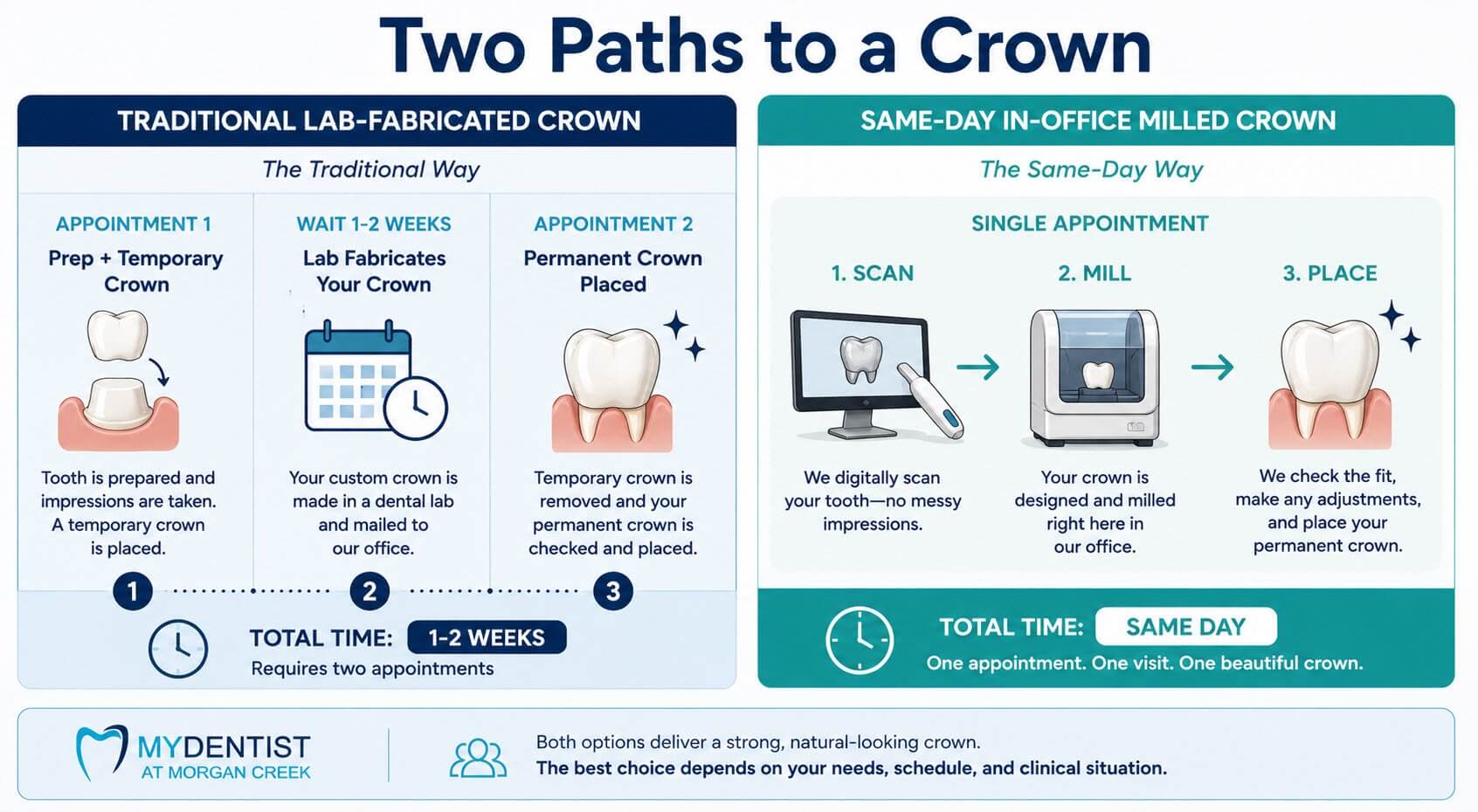
Practices with in-office milling equipment can skip the external lab entirely. A digital scanner captures your tooth, software designs the crown, and a milling unit carves it out of a ceramic block right there in the building, sometimes while you wait in the chair. No temporary crown, no second appointment, no two-week gap where you’re chewing carefully on one side of your mouth.
The per-appointment fee can look similar on paper between the two approaches. But when you account for the lab fee saved and the second appointment eliminated, same-day milling often works out to a comparable or slightly lower total cost, and it’s undeniably more convenient. Ask directly whether your practice offers this. Not every clinic has invested in the equipment, and it’s a fair question to ask before you commit to a treatment plan.
Preparatory Work
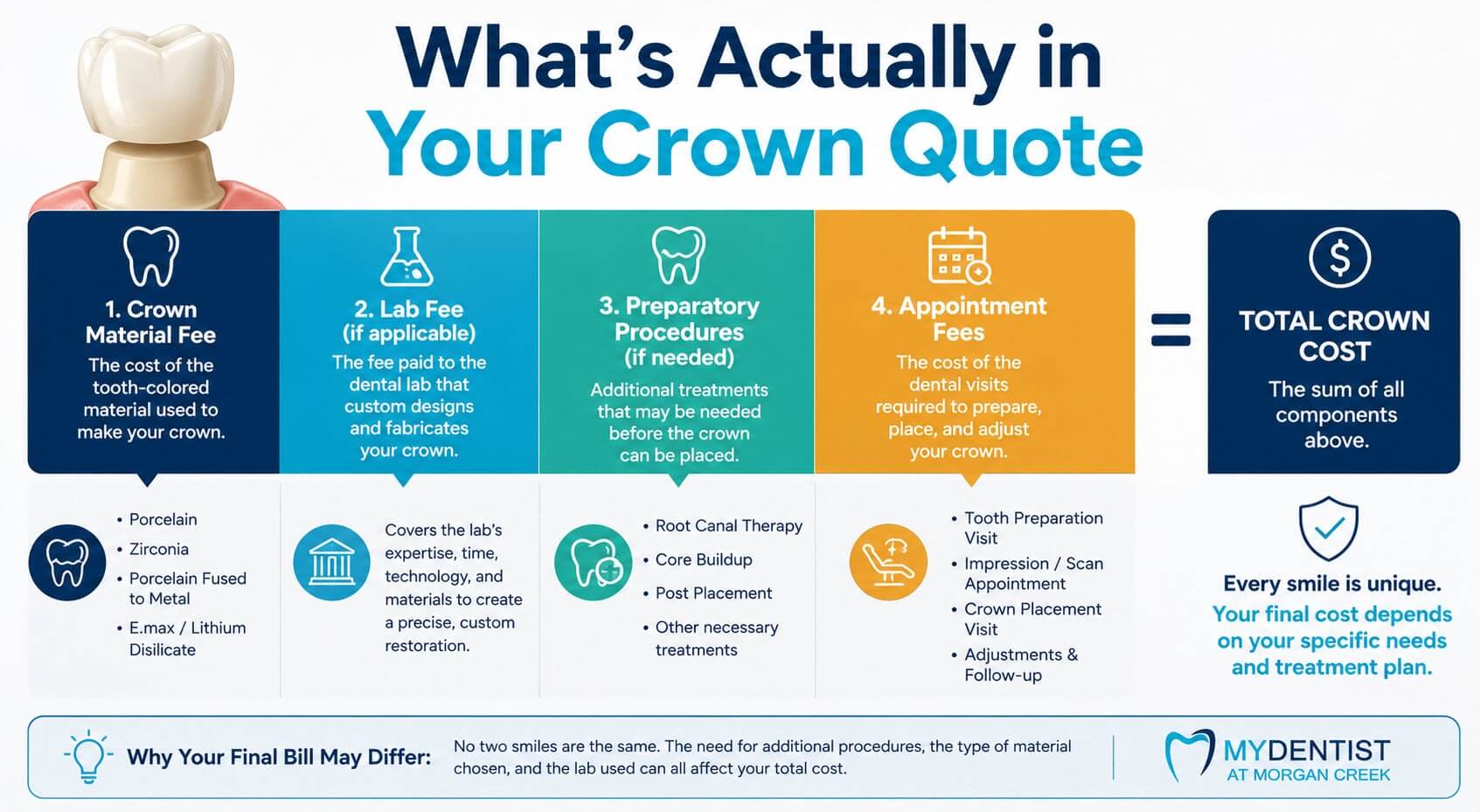
Here’s where a lot of the “my quote didn’t match what I actually paid” frustration comes from. A crown doesn’t exist in isolation. If the tooth underneath needs a root canal first, or needs a buildup because too much natural structure has broken down to support the crown on its own, or needs a post placed for additional retention, those are separate procedures with separate fees.
A dentist quoting you “$1,800 for a crown” without mentioning that you’ll also need a $900 root canal first isn’t being dishonest, necessarily, but it’s an incomplete picture. Before you agree to anything, ask for a full breakdown of every procedure the tooth will need from start to finish, not just the crown itself. A good practice will walk you through this without you having to ask twice.
Geographic Location
Overhead costs shape fees more than most patients realize. Rent, staff wages, and equipment costs are all higher in denser urban areas, and that gets reflected in what a practice needs to charge to stay sustainable. Fees in South Surrey and White Rock tend to sit in a moderate range relative to the rest of the Lower Mainland, generally below downtown Vancouver rates but above what you’d find in smaller, rural communities.
It’s worth noting that the BC Dental Association’s fee guide is a suggested reference, not a mandated price list. Practices set their own fees. That’s why calling two clinics a few kilometres apart can still turn up a real difference in quoted price, even for what looks like the same procedure.
Complexity of the Case
Not every crown is created equal from a clinical standpoint. A healthy tooth with strong surrounding bone and a straightforward root shape is a relatively simple case. A tooth with bone loss around it, an unusual or curved root anatomy, or a history of previous fillings and repairs is a more demanding case that requires more time, more precision, and often more clinical judgment to get right. The fee for a complex case reflects that additional skill and chair time, not an attempt to upsell you.
Does Dental Insurance Cover Crowns in Canada?
Most extended health benefit plans classify crowns under major restorative work, and coverage commonly falls between 50% and 80% of the eligible fee, subject to your plan’s annual maximum. A few details that trip people up more often than you’d expect:
- Waiting periods. Many plans require 12 months of continuous enrollment before major restorative benefits kick in. If you’re newly insured and need a crown right away, check this before you assume you’re covered.
- Alternate benefit clauses. This is the one that catches people off guard most often. Your insurer might only reimburse you at the rate of the least expensive clinically acceptable material, even if your dentist recommends zirconia for a good clinical reason. You’d still get zirconia, but you’d pay the difference between what insurance covers and what the material actually costs.
- Pre-authorization. This step is optional but genuinely worth the extra week it takes. Your dentist submits the treatment plan to your insurer before any work happens, and the insurer responds in writing with exactly what they’ll cover. No guessing, no surprises on the final invoice.
If you don’t have employer-sponsored coverage, individual dental plans are available through insurers like Sun Life and Manulife. And if you don’t have private insurance at all, it’s worth checking your eligibility for the federal Canadian Dental Care Plan (CDCP), which provides coverage for eligible Canadians who meet the income and insurance criteria.
Insurance Coverage at a Glance
| Coverage Detail | What to Know |
| Typical coverage percentage | 50% to 80% of the eligible fee |
| Annual maximum | Varies by plan, commonly 1,500–2,500 |
| Waiting period | Often 12 months for major restorative work |
| Alternate benefit clause | May cap reimbursement at the lowest-cost material |
| Pre-authorization | Recommended before treatment starts, not mandatory |
| No private insurance? | Check Canadian Dental Care Plan (CDCP) eligibility |
How to Reduce What You Pay Out of Pocket
Use Your Benefits Strategically
Benefit years reset on a set date, and unused coverage doesn’t roll over. If you’re near the end of your benefit year with room left in your annual maximum, timing a non-urgent crown before that reset date means you get more mileage out of this year’s coverage instead of leaving it on the table. On the other hand, if you’re already close to your annual max, it can make more financial sense to hold off on elective work until the new benefit year opens up, assuming the tooth isn’t urgent.
Ask for a Full Treatment Plan in Writing
This is the single most useful thing you can do before starting treatment, and it costs you nothing but a few minutes. Ask for an itemized estimate that lists every procedure code involved, not just the crown. This does two things: it lets your dentist submit an accurate pre-authorization to your insurer, and it gives you a real apples-to-apples comparison if you’re weighing material options or getting a second opinion elsewhere.
Don’t Delay Necessary Treatment
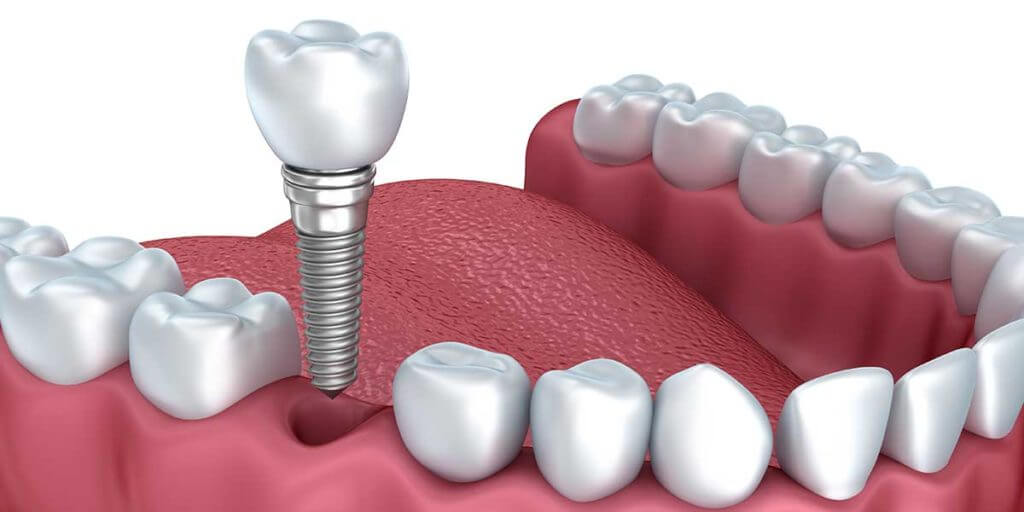
I’ve seen this pattern play out more times than I can count. A small cavity that needs a simple filling today gets left alone for a year and turns into a tooth that needs a crown. A tooth that needs a crown now, if left untreated, can fracture or decay to the point where it needs extraction and a dental implant, which costs several times more than the crown would have. Waiting rarely saves money. Crowns exist specifically to protect a weakened tooth from fracturing further, so treating it while it’s still a crown-sized problem, and not an extraction-sized one, is almost always the cheaper path in the long run.
Choose a Practice with Advanced Diagnostic Technology
Advanced dental technology doesn’t get talked about enough in cost discussions, but it matters. Practices using precise digital imaging and intraoral scanning tend to catch problems at an earlier stage, when treatment is simpler, faster, and less expensive. At My Dentist at Morgan Creek, the team uses Sirona 3-D imaging, 3-D printing, and iTero Lumina scanning. These tools don’t just make the process more comfortable (no more gagging on a mouthful of impression putty); they support more accurate treatment planning up front, which reduces the odds of running into an unexpected complication mid-procedure that adds cost and chair time.
Ask About Payment Options
Plenty of dental practices offer in-house payment plans or work with third-party financing companies. If cost is the main thing standing between you and treatment you actually need, have a direct conversation with the front desk before you assume the treatment is simply out of reach. Most practices would much rather work out a payment structure with you than have you delay care until the problem gets worse.
Cost-Saving Strategies Compared
| Strategy | Best For | Potential Savings |
| Timing treatment to your benefit year | Patients with unused coverage before renewal | Up to your full remaining annual max |
| Getting a written, itemized treatment plan | Anyone comparing options or seeking pre-authorization | Prevents surprise out-of-pocket costs |
| Treating problems early | Anyone with a diagnosed but untreated issue | Avoids costlier extraction/implant down the line |
| Choosing same-day milling (where available) | Patients wanting fewer appointments and no lab fee | Modest savings plus time saved |
| Asking about payment plans | Patients facing a larger out-of-pocket balance | Spreads cost, doesn’t reduce total but improves affordability |
What to Expect During the Crown Process
For a traditionally fabricated crown, plan on two appointments. At the first, your dentist numbs the area, shapes the tooth to make room for the crown, and takes either a physical impression or a digital scan. A temporary crown goes on to protect the tooth while the permanent one is being made. At the second appointment, usually one to two weeks later, the temporary comes off and the permanent crown gets checked for fit and bite before it’s cemented into place.
With in-office milling, the process compresses into a single visit. Digital scans replace the physical impression, the crown is designed on a computer, and it’s milled from a solid ceramic block while you wait, typically within an hour or two.
Either way, the procedure happens under local anesthetic, and most patients describe it as no more uncomfortable than getting a filling. Some mild sensitivity in the days after is normal, especially to temperature, and it typically settles down once the permanent crown is fully seated.
Getting a Crown in South Surrey / White Rock
If you’re in the South Surrey or White Rock area weighing your options, our team at My Dentist at Morgan Creek has been providing restorative dental care since 2001. Our dental practice uses digital imaging and scanning technology to support precise, efficient treatment planning, and can walk you through your material options, submit insurance pre-authorization on your behalf, and lay out the full cost of your treatment plan before any work begins.
Frequently Asked Questions
How much does a dental crown cost in BC in 2026?
In British Columbia, dental crown costs typically range from $1,000 to $2,500 per tooth, depending on the material, the complexity of the case, and the practice. Fees in South Surrey and White Rock generally align with the BC Dental Association’s suggested fee guide, though individual practices set their own rates.
Does provincial health care in BC cover dental crowns?
No. Routine dental care, including crowns, isn’t covered under BC’s provincial health plan (MSP) for most adults. Coverage comes through private extended health benefits, employer group plans, or federal programs like the Canadian Dental Care Plan for eligible individuals.
How long does a dental crown last?
With proper care, a crown typically lasts 10 to 15 years or longer. Zirconia and gold crowns tend to be among the most durable options. Regular checkups, good oral hygiene, and avoiding habits like grinding or chewing hard objects all help extend its lifespan.
Is a dental crown always necessary, or are there alternatives?
In some cases, a large filling or an inlay/onlay can restore a damaged tooth without a full crown. Your dentist will recommend a crown when the tooth is too damaged for a filling to hold reliably, when there’s a fracture risk, or following a root canal. The right choice depends on how much healthy tooth structure remains.
What’s the difference between a crown and a cap?
They’re the same thing. “Cap” is the informal term patients often use; “crown” is the clinical one. Both refer to a custom-made cover that fits over the entire visible portion of a tooth above the gum line.
Can I get a dental crown in one appointment?
Some practices with in-office milling technology can place a crown in a single visit using digital scans and same-day fabrication. Not every practice offers this, so it’s worth asking when you book your consultation.
How do I know if my insurance will cover my crown?
Request a pre-authorization from your insurer before treatment begins. Your dentist’s office can submit the treatment plan on your behalf, and your insurer will respond in writing with what they’ll cover. It removes the uncertainty and helps you plan for any out-of-pocket portion.
Making the Right Call for Your Tooth (and Your Wallet)
A dental crown is a real expense, there’s no getting around that. But framed correctly, it’s one of the more reliable investments you can make in keeping a tooth that would otherwise be lost. The patients who feel best about the process aren’t the ones who found the cheapest quote. They’re the ones who understood what they were paying for, asked for the full treatment plan up front, and used their insurance benefits with a bit of strategy instead of leaving money on the table.
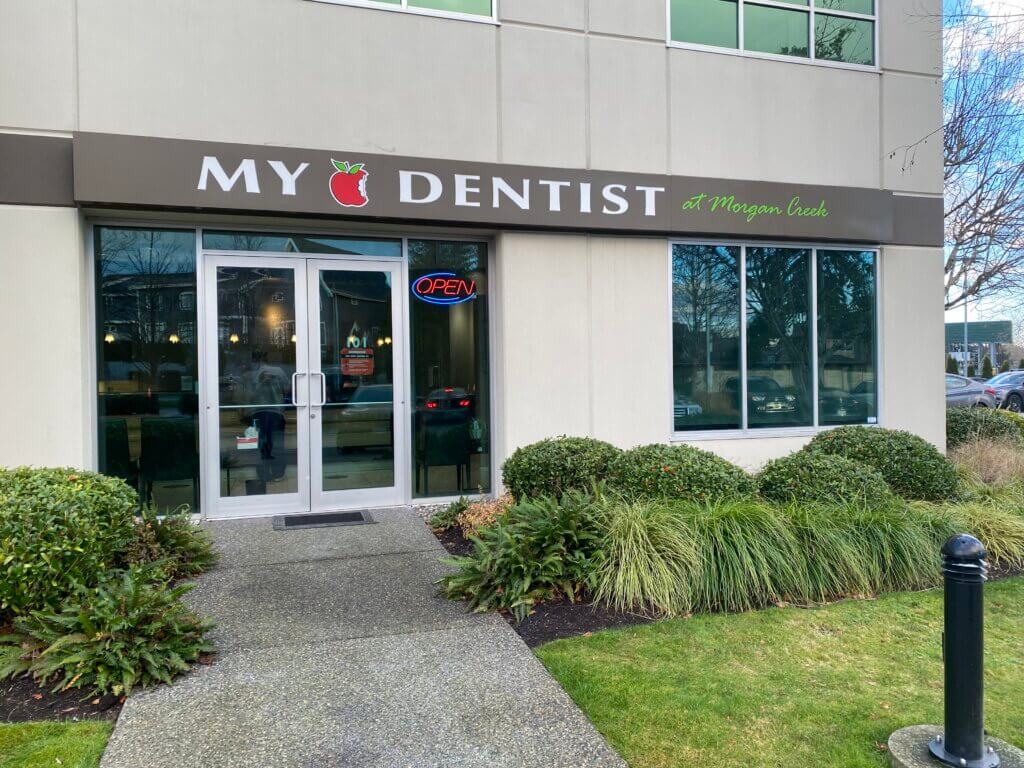
If a crown is on the horizon for you, the most useful thing you can do this week isn’t more searching. It’s booking a consultation where someone can look at your specific tooth, your specific insurance plan, and give you a specific number instead of a range. If you’re in South Surrey or White Rock, contact My Dentist at Morgan Creek to start that conversation.