


Losing most or all of your teeth changes more than your smile. It affects how you eat, how you speak, and how you feel about yourself day to day. Full-mouth dental implants offer a permanent way to restore that function and confidence, but they come with a significant investment and a multi-stage process that most people know very little about before their first consultation.
At My Dentist at Morgan Creek, we’ve sat across from hundreds of patients in this exact situation. They’ve done some Googling, they’ve heard conflicting things from friends, and they’re trying to figure out whether implants are really worth what they cost. Here’s what the treatment actually involves, what drives the cost, and what to ask before you commit.
What Are Full-Mouth Dental Implants?
Full-mouth dental implants replace all the teeth in your upper jaw, lower jaw, or both. Instead of a removable denture sitting over your gums, implants are anchored directly into the jawbone using titanium posts. Those posts fuse with the bone over time, creating a stable foundation for a full arch of replacement teeth.
You’ve probably heard terms like “All-on-4” or “teeth in a day” tossed around. Let’s break down what these actually mean and when each approach makes sense.
The Three Main Approaches
All-on-4 implants use four strategically placed posts per arch to support a fixed bridge of teeth. Two implants go in the front vertically, and two in the back are angled to maximize contact with available bone. This approach has become the gold standard for full-arch restoration because it often eliminates the need for bone grafting, even in patients with significant bone loss.
Here’s why that matters. When you lose teeth, your jawbone starts to shrink. Over time, there may not be enough bone in the back of your mouth to support traditional vertical implants. The angled placement in All-on-4 uses the denser bone that remains toward the front, which means many patients who were told they’d need extensive grafting can actually avoid it.
All-on-6 implants follow the same concept but use six posts instead of four. The extra two implants provide additional support and distribute chewing forces more evenly across the arch. This option works well for patients with adequate bone density who want maximum stability, particularly in the upper jaw where bite forces are higher.

We typically recommend All-on-6 for patients who grind their teeth, have particularly strong bite forces, or simply want that extra margin of security. The trade-off is higher cost and sometimes a longer healing period.
Individual implants for each tooth place a separate post for every missing tooth, typically requiring 8 to 14 implants per arch. This is the most involved and expensive option, but it offers the closest approximation to natural tooth roots and can provide superior long-term bone preservation in select cases.
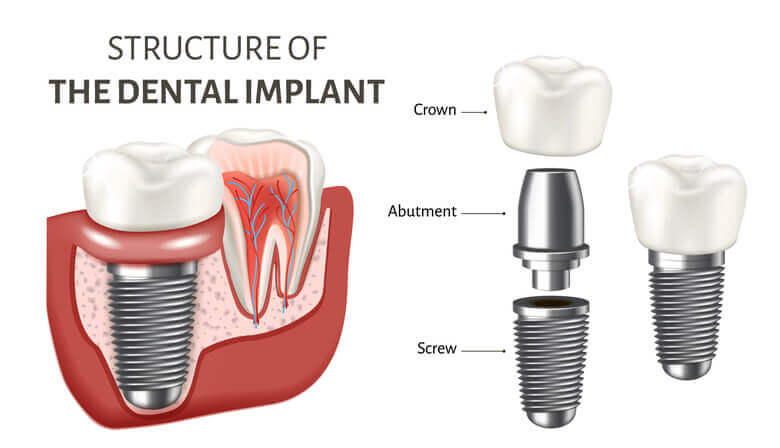
This approach makes sense when you have excellent bone density, you’re younger, and you want the most natural feel possible. It’s also the only option if you’re missing some teeth but not all, and you want to preserve as much bone as possible.
All-on-4 vs. All-on-6 vs. Individual Implants
| Feature | All-on-4 | All-on-6 | Individual Implants |
|---|---|---|---|
| Implants per arch | 4 | 6 | 8-14 (one per tooth) |
| Best for | Most patients, especially with moderate bone loss | Patients needing extra support or with higher bite forces | Cases requiring maximum bone preservation |
| Surgery time | Shorter (2-3 hours per arch) | Longer (3-4 hours per arch) | Longest (multiple appointments) |
| Cost per arch (Canada) | $15,000-$25,000 | $20,000-$30,000 | $35,000-$50,000+ |
| Bone grafting needed | Often avoidable | Sometimes required | More likely |
| Long-term stability | Excellent (95%+ success at 10 years) | Excellent to superior | Excellent |
| Recovery time | 3-6 months | 3-6 months | 6-12 months |
| Same-day temporary teeth | Usually yes | Sometimes | Rarely |
Your dentist will assess your bone density, gum health, bite forces, and overall oral health to determine which approach fits your situation. There’s no universally “best” option, only the best option for you.
What Does Full-Mouth Dental Implant Treatment Cost in Canada?
Let’s address the question everyone asks first. In Canada, a full-arch implant restoration typically ranges from roughly $15,000 to $30,000 per arch. A complete upper and lower restoration can reach $50,000 to $70,000 or more depending on the complexity involved.
What Drives Your Full-Mouth Implant Cost
| Cost Factor | Impact on Price | Why It Matters |
|---|---|---|
| Number of implants | $2,000-$5,000 per additional implant | More posts = more surgical time, materials, and lab work |
| Bone grafting | $1,500-$4,000 per site | Rebuilds jawbone density needed to support implants securely |
| Restoration material | Acrylic: $15K-$20K; Zirconia: $25K-$35K+ per arch | Zirconia looks more natural and lasts longer but costs more |
| Sedation type | Oral: $200-$500; IV: $800-$1,500 | Affects comfort level during surgery and recovery experience |
| Extractions needed | $200-$600 per tooth | Must remove damaged teeth before implant placement |
| Geographic location | Varies by 20-40% regionally | Urban centres and high-cost areas charge more |
| Dentist’s experience | Premium practices charge 15-30% more | Specialists with extensive implant training often deliver better outcomes |
We know that’s a wide range, and it exists for good reasons. Here’s what moves the number up or down.
Number of Implant Posts
Fewer posts generally means lower surgical costs. An All-on-4 approach uses four posts per arch, while All-on-6 uses six. If your case calls for individual implants for each tooth, you’re looking at 8 to 14 posts per arch, which significantly increases both surgical time and material costs.
Each implant post costs between $2,000 and $5,000 when you factor in the surgical placement, the implant itself, and the abutment that connects to the final restoration. Multiply that by the number of implants, and you start to see why the total adds up quickly.
Bone Grafting
If you’ve been missing teeth for some time, your jawbone may have lost density. Before implants can be placed, a bone graft may be needed to rebuild enough structure to hold the posts securely. Grafting adds both cost, typically $1,500 to $4,000 per site, and several months of healing time to the overall treatment.

One advantage of the All-on-4 technique is that the angled posterior implants often engage existing bone in areas that haven’t resorbed as much, which means many patients can avoid grafting altogether. This is one of the main reasons All-on-4 has become so popular. It’s not just about using fewer implants. It’s about working with the bone you have instead of trying to rebuild what’s gone.
Type of Final Restoration
The teeth that attach to your implant posts come in different materials, and this choice affects both cost and longevity. Acrylic or hybrid restorations cost less, usually in the $15,000 to $20,000 per arch range. Full zirconia arches cost more, often $25,000 to $35,000+ per arch, but they’re more durable, resist staining better, and look closer to natural teeth.
Think of it this way. You’re making a choice between a good long-term solution and a great long-term solution. Both work, but one will likely outlast the other by a decade or more. If you’re in your 50s or 60s and you want something that will carry you through the rest of your life with minimal maintenance, zirconia is worth the extra investment. If budget is a real constraint, acrylic will still give you a functional, attractive result.
Sedation and Anaesthesia
Full-mouth implant surgery is a significant procedure, and many patients choose sedation to stay comfortable throughout. Whether you use oral sedation, nitrous oxide, or IV sedation affects the overall cost. Oral sedation typically adds $200 to $500, while IV sedation can add $800 to $1,500 or more.
Most patients opt for some form of sedation, and it’s worth the investment. You’ll be more relaxed during surgery, which can actually help the procedure go more smoothly. We’ve seen patients who tried to tough it out with just local anaesthesia end up moving or tensing up, which makes the surgeon’s job harder and can extend the time you’re in the chair.
Complexity and Preparatory Work
Some patients need extractions, gum treatment, or other work before implant placement can begin. Each additional step adds to the total. If you need multiple extractions at $200 to $600 per tooth, or treatment for active gum disease, those costs accumulate quickly.
Here’s something we wish more patients knew going in. If you still have some teeth that can be saved, it’s often worth doing the work to save them rather than extracting everything and going straight to full-mouth implants. Natural teeth, even compromised ones, often function better than implants in the short to medium term. The decision to extract everything should be made carefully, not as a convenient way to avoid other dental work.
Geographic Location and Provider Experience
Where you live matters. Urban centers and high-cost regions charge more, sometimes 20 to 40 percent above smaller markets. Similarly, specialists with extensive implant training and years of experience often charge premium fees, but they’re also more likely to deliver predictable, long-lasting results.
This isn’t an area where you want to shop strictly on price. The skill of your surgeon and the quality of your restoration affect how well your implants function and how long they last. We’ve seen patients save a few thousand dollars upfront only to end up with complications, failed implants, or restorations that need replacing far sooner than expected. The math doesn’t work out.
Does Dental Insurance Cover Full-Mouth Implants?
Most standard dental insurance plans in Canada cover little to none of the implant cost itself. Some plans may contribute toward the crown or restoration component, but surgical placement is often excluded or subject to annual maximums that fall well short of the total treatment cost.
If you’re enrolled in the Canadian Dental Care Plan (CDCP), coverage for implants under that program is limited. The CDCP focuses primarily on preventive and basic restorative care. It’s worth confirming exactly what your specific plan covers before you begin.
That said, flexible payment options can make a real difference. Many clinics work with patients on payment arrangements and can direct-bill most insurance providers for any covered portions, so you’re not managing the paperwork on your own.
Some patients also use medical financing companies that specialize in healthcare procedures, offering monthly payment plans with competitive interest rates. It’s worth asking your dental office what options they offer. We’ve seen patients spread the cost over 12 to 24 months, which makes the monthly payments much more manageable than a single lump sum.
The Full-Mouth Implant Process, Step by Step
Full-mouth implants are not a single-appointment treatment. The process typically spans several months, and understanding the timeline helps you plan realistically. Here’s what you can expect at each stage.
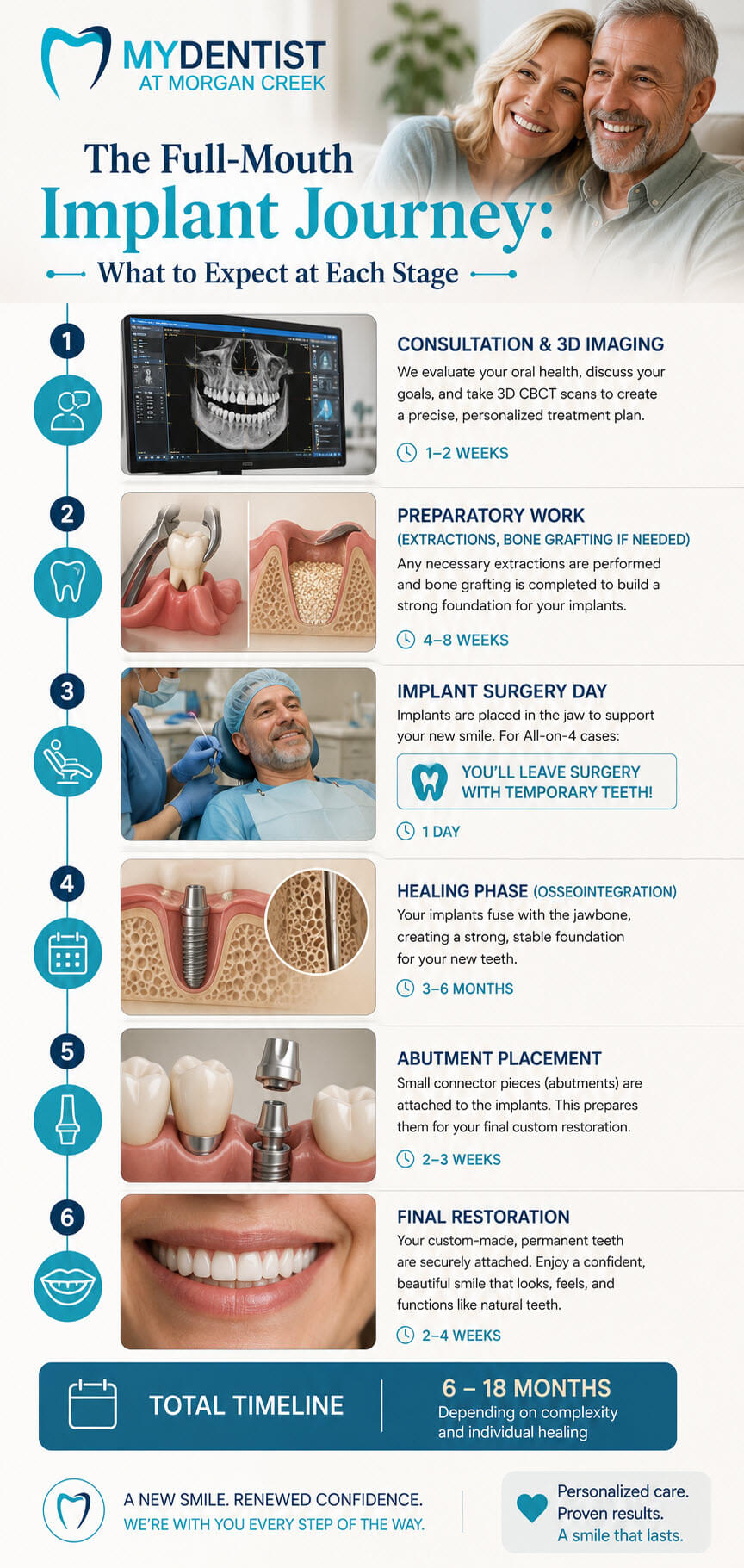
Step 1: Comprehensive Consultation and Imaging
Your dentist takes X-rays and often a 3D cone beam CT scan to assess bone structure, nerve positions, and overall oral health. This imaging guides the entire treatment plan and helps your surgeon place implants with precision.
This appointment is also where you’ll discuss your goals, review your medical history, and get a clear picture of what your treatment will involve. Don’t hesitate to ask questions here. This is the time to understand exactly what you’re signing up for.
Ask about the surgeon’s experience with full-mouth cases. Ask to see before-and-after photos of patients with similar situations to yours. Ask what happens if an implant fails. A good provider will welcome these questions and give you straightforward answers.
Step 2: Preparatory Treatments
Remaining teeth that need extraction, active gum disease, or insufficient bone density are addressed before anything else. Skipping this step would compromise the implants down the line.
If you need extractions, your dentist may place the implants immediately after removing the teeth, or they may wait several weeks for the sites to heal first. If bone grafting is needed, that adds several months of healing time before implants can be placed.
Here’s a practical tip. If you’re having multiple extractions, ask about doing them in stages rather than all at once. Some patients find it easier to chew and heal when they still have some teeth on one side of their mouth while the other side recovers.
Step 3: Implant Placement Surgery
The titanium posts are surgically placed into the jawbone, typically under local anaesthesia with sedation available for patients who want it. The surgery itself takes 2 to 4 hours per arch, depending on the number of implants and whether extractions are being done at the same time.
In some All-on-4 cases, temporary teeth can be fitted the same day, sometimes marketed as “teeth in a day.” This isn’t possible for everyone. It depends on bone quality, the number of implants placed, and your surgeon’s clinical judgment. Your treatment plan will clarify whether this is an option for you.
If you do get same-day temporaries, understand that they’re just that. Temporary. They look good and function well enough for normal eating and socializing, but they’re not meant to last. You’ll still need to go through the healing phase and get your final restoration once osseointegration is complete.
Step 4: Osseointegration
This is the healing phase. Over the next three to six months, the bone grows around and fuses with each implant post. This process is what makes implants stable and long-lasting. It can’t be rushed.
During this time, you’ll wear temporary teeth that look and function well enough for normal eating and socializing, but you’ll need to avoid particularly hard or sticky foods that could disturb the healing implants. Think soft meats, cooked vegetables, pasta, rice. No biting into apples or tearing at tough steaks.
We tell our patients to treat this period like you’re training for a marathon. You’ve done the hard work of surgery. Now you need to protect your investment while your body does its job. The temptation to test your new teeth is real, but patience here pays off in the long run.
Step 5: Abutment Placement
Once osseointegration is confirmed through X-rays, small connector pieces called abutments are attached to the posts. These are what the final restoration attaches to. This is a minor procedure, often done under local anaesthesia, and you’ll be back to normal activities within a day or two.
Some patients experience mild soreness for a day or two after abutment placement. Over-the-counter pain relievers usually handle it. Your gums may need a week or so to heal around the abutments before the final impressions are taken.
Step 6: Final Restoration
Impressions or digital scans are taken and sent to a dental lab. Your final arch, whether acrylic, hybrid, or zirconia, is custom-made and fitted, with adjustments made until the bite feels right.
This is the moment you’ve been waiting for. Your permanent teeth are attached, and you’ll leave with a fully functional, natural-looking smile. Most patients need a follow-up visit within a few weeks to fine-tune the bite and ensure everything is comfortable.
Don’t be surprised if your bite feels slightly off for the first few days. Your brain and muscles need time to adjust to the new tooth positions. If something feels genuinely wrong or painful after a week or two, call your dentist. Small adjustments can make a big difference.
Total Timeline
Most patients complete the full process in six to twelve months. Cases requiring bone grafting can extend that to eighteen months or longer. The osseointegration phase alone takes three to six months and can’t be shortened, so patience is essential.
We know that sounds like a long time when you’re missing teeth and you want this done. But rushing the process is how implants fail. The timeline exists for biological reasons, not because dentists want to drag things out.
Are Full-Mouth Implants Worth It?
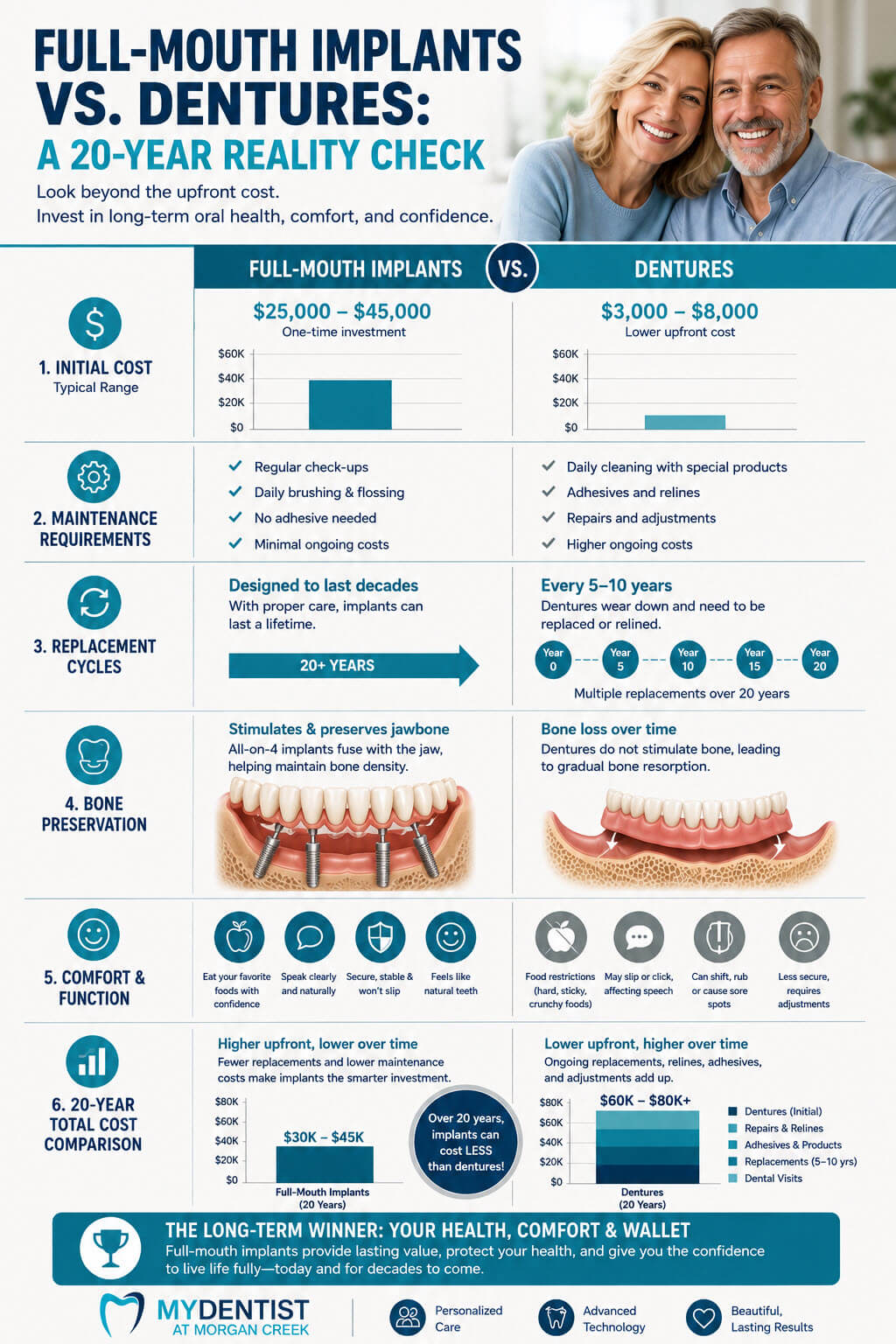
For many patients, yes. Unlike dentures, implants don’t slip, don’t require adhesive, and don’t need to come out at night. They stimulate the jawbone, which helps prevent the bone loss that typically follows tooth loss. With proper care, implant restorations can last decades.
Long-term studies show that dental implants have a 10-year survival rate of 93 to 96 percent, and even at 20 years, roughly 4 out of 5 implants are still functioning well. That’s a track record most medical procedures would envy.
The comparison to dentures is worth making honestly. A well-made set of dentures costs far less upfront, typically $3,000 to $8,000 for a full upper and lower set. But they often need relining or replacing every five to ten years, and many patients find them uncomfortable or limiting.
Over a twenty-year period, the total cost difference narrows more than most people expect. When you factor in denture adhesives, cleaning solutions, replacement costs, and the ongoing bone loss that can change your facial structure over time, implants start to look like the more practical choice for many patients.
Here’s something we see regularly. Patients come in wearing dentures they’ve had for 15 or 20 years. Their jawbone has shrunk significantly, their face has lost support, and they look older than they should. The dentures slip when they talk or eat, and they’ve stopped going out to restaurants or social events because they’re self-conscious.
Then they get implants. Six months later, they’re eating foods they haven’t touched in years. They’re laughing without covering their mouth. They’re booking dinners with friends instead of making excuses. That’s not just about teeth. That’s about quality of life.
Beyond the financials, there’s the quality-of-life factor. Patients with implants report eating a wider variety of foods, speaking more confidently, and feeling more comfortable in social situations. They don’t worry about their teeth slipping or clicking during conversations. They don’t have to remove them at night or soak them in a cup.
If you’re weighing your options, a detailed consultation is the only way to get numbers that reflect your specific situation, not a general range from the internet.
Frequently Asked Questions
How much do full-mouth dental implants cost in Canada?
The cost varies significantly based on the number of implants, the type of restoration, whether bone grafting is needed, and the complexity of your case. A full-arch restoration generally ranges from around $15,000 to $30,000 per arch, and a complete upper and lower restoration can be higher. A consultation with your dentist is the only way to get an accurate estimate for your specific situation.
How long does the full-mouth implant process take?
Most patients complete treatment in six to twelve months. Cases requiring bone grafting or significant preparatory work can take up to eighteen months or longer. The osseointegration phase alone, where the bone fuses with the implant posts, takes three to six months and can’t be shortened.
Does the Canadian Dental Care Plan cover dental implants?
The CDCP focuses primarily on preventive and basic restorative care, and coverage for implants under the plan is limited. Confirm the specifics of your plan with your dental provider before starting treatment.
What is the difference between All-on-4 and All-on-6 implants?
All-on-4 uses four implant posts per arch to support a full bridge of teeth, while All-on-6 uses six posts. All-on-4 is typically faster, less expensive, and can often avoid bone grafting. All-on-6 provides additional support and may be recommended for patients with higher bite forces or those seeking maximum stability. Your dentist will recommend the approach that suits your bone structure and goals.
Is sedation available for implant surgery?
Yes. Full-mouth implant placement is a significant procedure and sedation is commonly used. Options may include oral sedation, nitrous oxide, or IV sedation. Most clinics offer sedation dentistry for patients who want a more comfortable experience.
Can I get temporary teeth while my implants heal?
In many All-on-4 cases, temporary teeth can be placed the same day as surgery. This isn’t possible in every situation. It depends on bone quality, the number of implants placed, and your dentist’s clinical judgment. Your treatment plan will clarify whether this is an option for you.
What happens if I don’t have enough bone for implants?
A bone graft may be performed before or at the time of implant placement. Grafting adds time and cost to the process but makes implants possible for many patients who would otherwise not be candidates. Your dentist will assess this during the initial consultation and imaging phase. The All-on-4 technique, with its angled posterior implants, often allows patients to avoid grafting by engaging existing bone in areas that haven’t resorbed as much.
How long do full-mouth implants last?
With proper care, dental implants can last decades. Studies show 10-year survival rates of 93 to 96 percent, and even at 20 years, roughly 80 percent of implants are still functioning well. The restoration itself, the visible teeth attached to the implants, may need replacement after 15 to 20 years depending on the material and how well you maintain them. Good oral hygiene, regular dental checkups, and avoiding habits like smoking or chewing hard objects all contribute to long-term success.
What if an implant fails?
It happens, though it’s uncommon. If an implant doesn’t integrate properly or fails later due to infection or other issues, it can usually be removed and replaced. The success rate for replacement implants is still high, though the overall timeline extends. This is one reason choosing an experienced surgeon matters. They’ll place your implants in positions that maximize success and make any future complications easier to address.
Talking to Your Dentist About Implants in South Surrey / White Rock
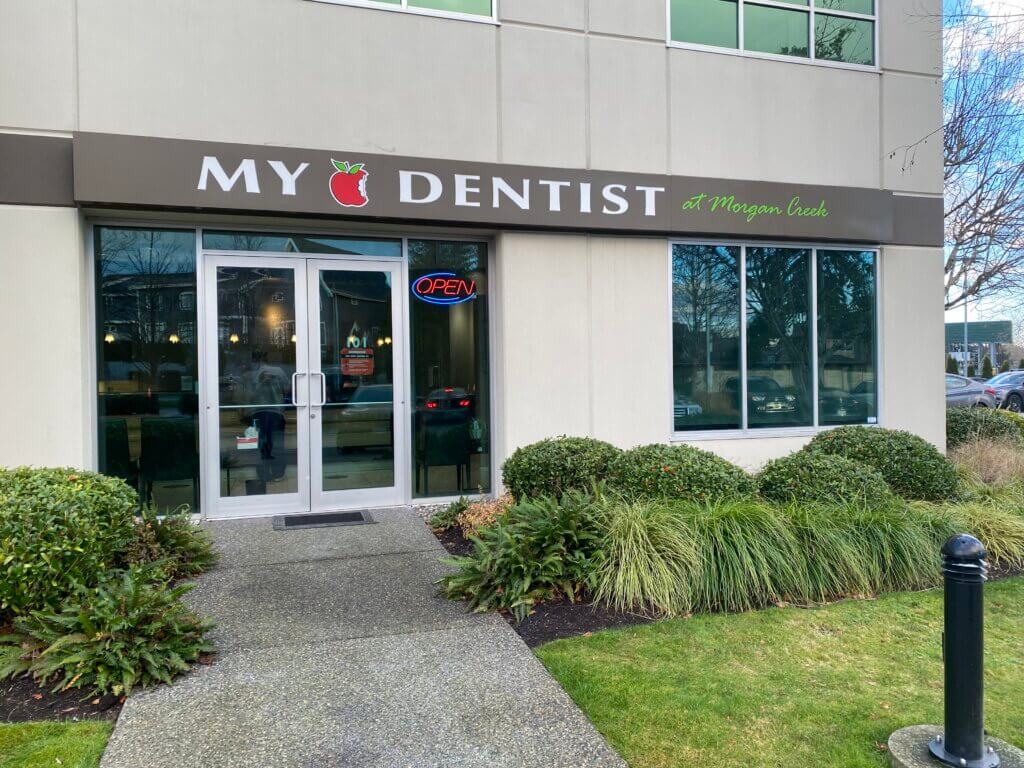
If you’re considering full-mouth implants and you’re based in South Surrey / White Rock, BC, the first step is a thorough exam and an honest conversation about what your case involves. My Dentist at Morgan Creek offers dental implants as part of a full range of restorative services. The team can walk you through what your treatment plan would look like, what preparatory steps might be needed, and how to approach the cost practically.
Direct billing to most insurance providers is available, and the clinic accepts the Canadian Dental Care Plan for any covered services.
Book your consultation at My Dentist at Morgan Creek or call the clinic directly at 778-742-5731 to get started.